A Family Portrait for a New Gilded Age
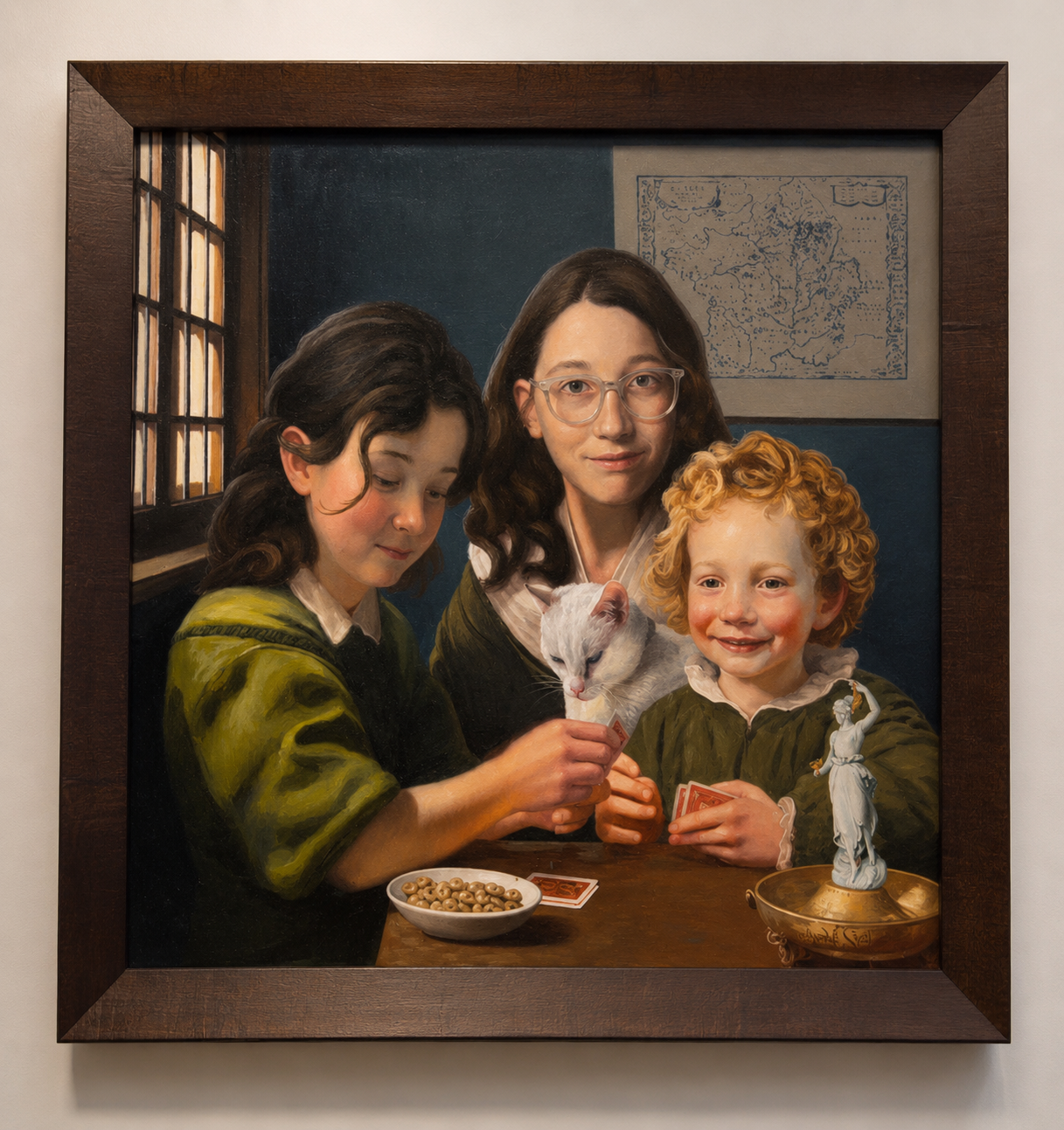
Richard T. Scott, The Larroque Children, 2026, oil on canvas, 30" x 36"
It began with an argument over holiday cards.
Like many families, we had adopted the annual tradition of taking a family photograph to share with friends and relatives. I preferred hiring a professional photographer; my husband favored a casual snapshot. When I looked into estimates, the cost of photography, printing, and postage quickly climbed to a significant amount.
Exasperated, my husband muttered, “For that price, we could get a painting.”
He was joking, but he was also onto something.
The cost of living in America has reached absurd heights. We seem to be entering a new Gilded Age—an era in which some families distribute carefully curated images of abundance while others struggle to afford necessities. The comparison to the late nineteenth century felt unavoidable. The robber barons of that era amassed enormous fortunes through industrial monopolies and financial power. The parallels to today's technology giants are not lost on anyone.The premier portraitist of that age was John Singer Sargent (1856–1925). His paintings became status symbols for wealthy industrialists and social elites, capturing the confidence, elegance, and excess of an era defined by extraordinary wealth and profound inequality.
Instead of spending money on an ephemeral photograph, I began to wonder: why not commission a painting?
I immediately thought of Richard T. Scott—an accomplished contemporary Baroque painter, former Jeff Koons studio staffer, and husband of a childhood friend.
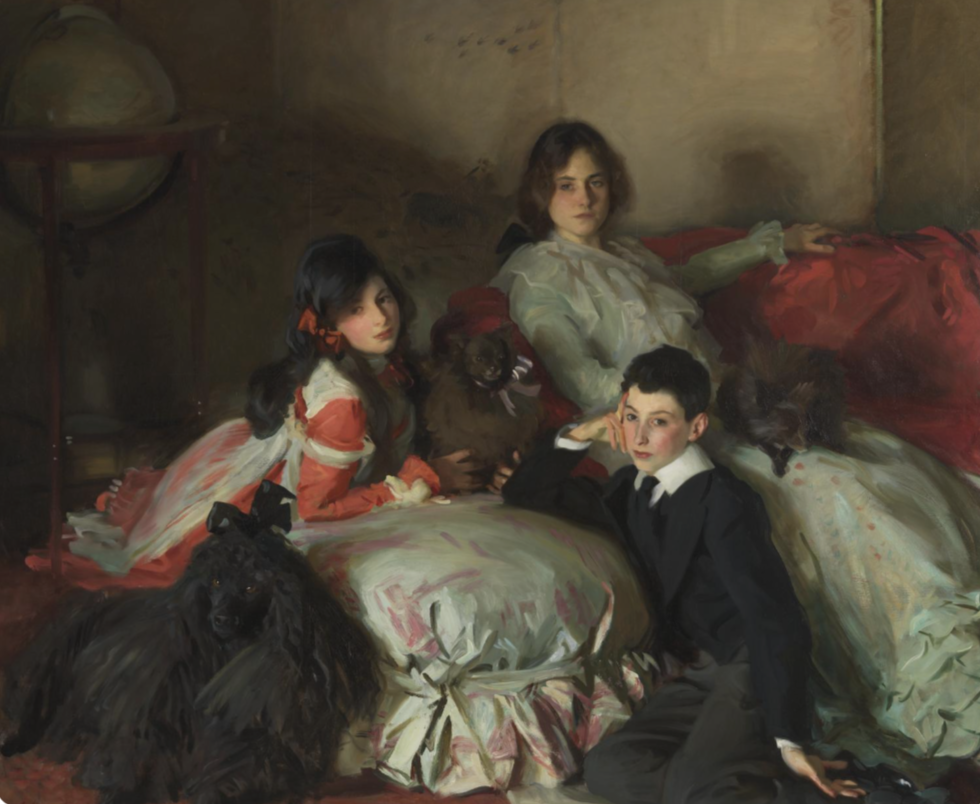
The portrait would feature our three children: Charlotte, age ten; Genevieve, age eight; and Olivier, age three. I wanted the painting to acknowledge my husband's French heritage while reflecting our distinctly American family. Richard immediately referenced The Wertheimer Portraits, the celebrated series of family portraits that John Singer Sargent painted for British art dealer Asher Wertheimer and his children.
Inspiration
John Singer Sargent, Essie, Ruby and Ferdinand, Children of Asher Wertheimer, 1902, oil on canvas, 63.5 in × 76.3 in, Tate Britain
I shared Google albums containing thousands of photographs of the children, and Richard developed several compositional studies. The final work is a highly finished realist portrait that seamlessly blends historical reference with contemporary family likeness.
The three Larroque children are gathered around a table engaged in a card game. Charlotte occupies the center of the composition, her direct gaze establishing a connection with the viewer. In her lap rests Pistache, our white cat. Genevieve appears to the left, absorbed in the game, while three-year-old Ollie sits to the right, smiling as he clutches a hand of cards.Their clothing evokes seventeenth-century Dutch and Flemish portraiture through muted colors, broad collars, and period-inspired tailoring. Yet we deliberately retained modern details like Charlotte's glasses.
The painting is conceived in the visual language of Dutch Golden Age genre painting. Light enters through a window reminiscent of Vermeer's The Milkmaid (c. 1658), while the intimate domestic setting recalls the quiet narratives of artists such as Metsu and Ter Borch. Richard enriches these references with personal symbolism. A map of France hangs on the rear wall, acknowledging the family's French roots. In the foreground, a small classical statue representing Hebe, the goddess of youth, serves as a subtle memento mori—a reminder of both the permanence of art and the fleeting nature of childhood.
The result is warm, affectionate, and deeply intimate. It is playful without sacrificing seriousness, historical without feeling nostalgic. Most importantly, the painting places contemporary subjects within an imagined historical world, a theme central to Richard’s oeuvre.
It asks us to see an ordinary family moment through the lens of time—to imagine how today's children might be remembered generations from now.
“Art is long, Time is fleeting”

The Larrqoue Family
A family photo from the previous year (2024)
About the Artist: Richard T. Scott
Richard T. Scott (b. 1980) is an American Baroque painter and writer based in the Hudson Valley and Savannah, Georgia, where he teaches at the Savannah College of Art and Design. His work is held in museum collections throughout North America, Europe, and Asia. Scott previously served in the United States Mint's Artistic Infusion Program, designing coins and Congressional Gold Medals.
Current Exhibition
Richard T. Scott's work will be on view in Fantastic Refuge, a two-person exhibition with Jordan Nobuko Baker, from June 6 through July 1, 2026, at Galerie L'Oeil du Prince, 3 Avenue du Maréchal Foch, Biarritz, France.